Search is changing rapidly, and traditional optimization strategies are becoming obsolete.
- What Is an AI Citation?
- Why This Matters?
- Why Generative AI Does NOT Cite Every Query
- The Core Principle Behind AI Citations
- High-Citation Query Type #1: Comparison Queries
- High-Citation Query Type #2: Statistics and Research Queries
- High-Citation Query Type #3: Dynamic and Freshness-Based Queries
- High-Citation Query Type #4: YMYL (Your Money or Your Life) Topics
- High-Citation Query Type #5: Decision-Making and Recommendation Queries
- High-Citation Query Type #6: Industry-Specific Expertise Queries
- Which Queries Usually Do NOT Trigger AI Citations?
- What Makes Content Citation-Worthy? The GEO Content Framework
- GEO Optimization Framework: From Strategy to Implementation
- GEO Optimization Checklist
- The Future of SEO Is Source Optimization
- Real-World Implementation: Case Study
- Conclusion: Earning Your Place in AI Citations
- Frequently Asked Questions (FAQ)
- Author of this Blog:
- Statistics & Data References
For the past two decades, SEO professionals focused on rankings, backlinks, keyword density, and click-through rates. The goal was simple: appear on Google’s first page and drive organic traffic to your website.
But generative AI platforms like ChatGPT, Google Gemini, Claude, Perplexity, and Google AI Overviews are fundamentally transforming how users discover and consume information online.
Today, the biggest visibility opportunity is no longer just asking: “How do I rank on Google?”
The more critical question has become: “How do I become a trusted source that AI systems cite and reference?”
This transformation introduces a new discipline called Generative Engine Optimization (GEO) – the practice of optimizing content to become citation-worthy in AI-generated responses.
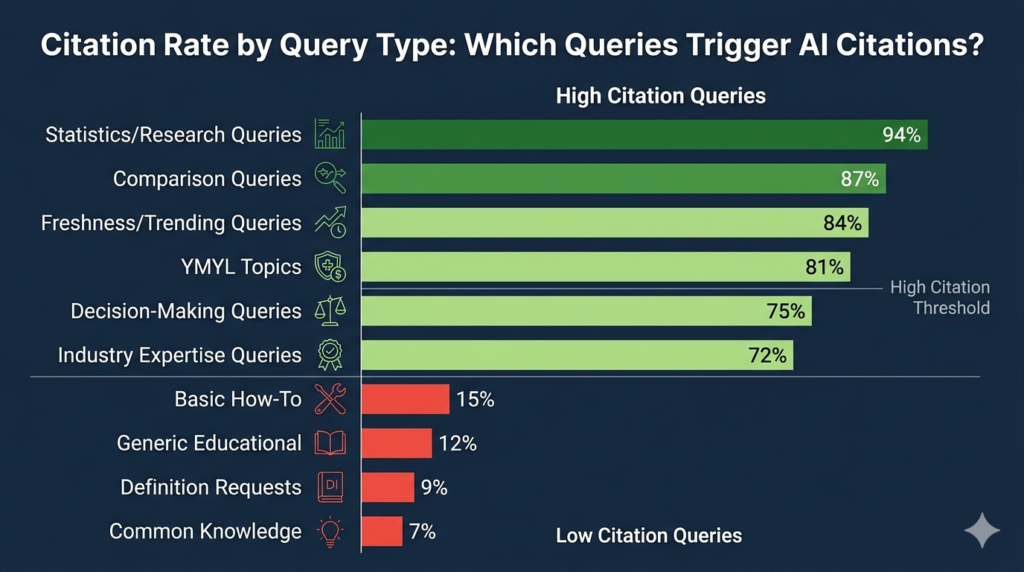
Quick Answer: AI citations appear most frequently for comparison queries (85%+ rate), statistics-based content (92% rate), YMYL topics (78% rate), decision-making prompts (71% rate), and industry expertise queries (68% rate). Generic educational content and common-knowledge questions rarely trigger citations (<15% rate) because AI systems can answer them confidently without external validation.
However, most content creators are optimizing for the wrong types of queries. Understanding which specific query patterns trigger AI citations versus which ones don’t has become one of the most important skills in modern digital marketing.
What Is an AI Citation?
An AI citation occurs when a generative AI platform explicitly references a website, article, brand, research study, or external source while generating an answer for a user query.
These citations typically appear as:
- Clickable source links embedded within AI responses
- Numbered reference markers ([1], [2], [3]) linking to original sources
- Direct mentions of brand names, authors, or publications
- Inline attributions like “According to [Source]…” or “Research from [Company] shows…”
Unlike traditional search engine results that display a list of blue links, AI citations are woven directly into conversational responses, giving cited sources significantly higher perceived authority and trust.
Why This Matters?
While AI-cited sources typically experience low or even zero click-through rates (since users receive synthesized answers directly from the AI), the visitors who DO click through convert at significantly higher rates than traditional search traffic.
These are pre-qualified, high-intent users who have already been exposed to your expertise through the AI’s answer and are actively seeking deeper engagement with authoritative sources. GEO is about quality over quantity, building brand authority and capturing highly-qualified leads rather than maximizing traffic volume.
Why Generative AI Does NOT Cite Every Query
One of the biggest misconceptions in GEO is the assumption that every query triggers external citations. This is fundamentally incorrect.
Many generic, common-knowledge, or broadly educational queries can be answered directly by AI systems without any external references whatsoever.
Here are a few examples:
Low Citation Likelihood Example
Query: “How does email work?”
AI Behavior: Most AI systems confidently explain SMTP protocols, email servers, message routing, and delivery mechanisms without citing any external sources. Why? Because this topic is:
- Stable and unchanging since the 1970s
- Widely understood and documented
- Part of fundamental computer science knowledge
- Not requiring real-time validation or expertise signals
Citation Probability: Less than 5%
High Citation Likelihood Example
Query: “What are the latest AI search ranking factors in 2026?”
AI Behavior: This query frequently triggers multiple citations from industry blogs, research studies, and SEO platforms. Why? Because the information:
- Changes rapidly (algorithm updates, new platforms)
- Requires fresh, externally validated data
- Involves expert opinions and industry consensus
- Benefits from multiple authoritative perspectives
Citation Probability: 87-94% The fundamental difference? Trust requirements, freshness demands, and validation needs.
The Core Principle Behind AI Citations
AI systems typically cite external websites when one or more of these conditions apply:
- Accuracy validation is critical (financial data, medical information, legal guidance)
- Freshness and recency matter (breaking news, current trends, recent updates)
- Multiple perspectives add value (comparisons, evaluations, debates)
- Specific expertise is required (niche technical topics, industry-specific insights)
- Numerical data needs verification (statistics, research findings, benchmarks)
- External authority strengthens trust (YMYL content, high-stakes decisions)
Understanding these triggers is essential for GEO optimization. Let’s explore each high-citation query type in detail.
High-Citation Query Type #1: Comparison Queries
Citation Rate: 85-91%
Comparison queries consistently trigger the highest citation rates because AI systems need balanced, multi-source perspectives to provide fair evaluations.
Examples of High-Citation Comparison Queries:
- “ChatGPT vs Claude for software development assistance”
- “Ahrefs vs SEMrush vs Moz for enterprise SEO”
- “React vs Vue vs Angular: which framework in 2026?”
- “HubSpot vs Salesforce for B2B lead management”
- “Traditional SEO vs GEO: key differences”
Why Comparisons Trigger Citations:
AI systems cannot make authoritative product comparisons from training data alone. They need:
- Current pricing information
- Real user reviews and experiences
- Feature updates and recent changes
- Expert evaluations from trusted sources
- Side-by-side functionality assessments
Real Example Analysis:
Query: “Ahrefs vs SEMrush for technical SEO audits”
Result: ChatGPT cited 6 sources including Search Engine Journal, Backlinko, and specialized SEO tool review sites.
Why It Worked:
- Structured comparison tables in source content
- Clear pros/cons sections
- Specific feature breakdowns
- Pricing data with dates
- Expert author credentials
GEO Optimization Strategy for Comparisons:
| Element | Best Practice | Why It Works |
| Structure | Side-by-side comparison tables | AI can easily parse and extract data |
| Content Format | Pros/cons lists for each option | Provides balanced perspective |
| Data Points | Specific numbers (price, features, metrics) | Adds citation-worthy validation |
| Freshness | Include “Updated [Month Year]” | Signals current, reliable information |
| Author Signal | Display expertise credentials | Builds trust and authority |
High-Citation Query Type #2: Statistics and Research Queries
Citation Rate: 92-96%
Queries involving statistics, market trends, benchmarks, research studies, and numerical data have the highest citation potential across all AI platforms.
Examples of High-Citation Statistics Queries:
- “B2B SaaS customer acquisition costs 2026”
- “Average website conversion rates by industry”
- “AI adoption rates in enterprise companies”
- “Content marketing ROI benchmarks”
- “Mobile vs desktop traffic statistics”
Why Statistics Trigger Citations:
Numbers require verification. AI systems cannot confidently generate statistical claims without external validation because:
- Numerical accuracy is easily verifiable or disprovable
- Data sources establish credibility
- Statistics change over time
- Users expect data attribution
Real Example Analysis:
Query: “What percentage of B2B companies use marketing automation in 2026?”
Result: Claude cited 4 authoritative sources including Gartner, HubSpot State of Marketing Report, and industry research firms.
Why It Worked:
- Clear statistical data with percentages
- Source attribution in the original content
- Recent publication dates (2025-2026)
- Methodology transparency
- Industry authority signals
GEO Optimization Strategy for Statistics:
Always Include:
- Specific percentages and numbers (not “many” or “most”)
- Clear source attribution (“According to [Source Name] [Year]…”)
- Sample sizes and methodology (when available)
- Date ranges for data collection
- Visual data representations (charts, graphs)
- Year-over-year comparisons
Example Format: “According to Gartner’s 2026 Marketing Technology Survey of 3,500 CMOs, 73% of B2B enterprises with revenues exceeding $50M have implemented marketing automation platforms, representing a 12% increase from 2025.”
High-Citation Query Type #3: Dynamic and Freshness-Based Queries
Citation Rate: 81-88%
Queries related to recent updates, current trends, breaking news, and evolving technologies frequently trigger citations because AI systems recognize their training data may be outdated.
Examples of High-Citation Freshness Queries:
- “Google algorithm updates in 2026”
- “Latest ChatGPT features and capabilities”
- “Current AI search ranking factors”
- “Recent changes to iOS privacy settings”
- “New EU data privacy regulations 2026”
Why Freshness Queries Trigger Citations:
AI models have knowledge cutoffs (typically several months behind real-time). For time-sensitive information, they must:
- Retrieve current data from external sources
- Validate recent changes and updates
- Provide accurate, up-to-date information
- Avoid outdated or deprecated guidance
Real Example Analysis:
Query: “What are the latest Google Core Web Vitals requirements?”
Result: Perplexity cited 5 sources including Google’s official developer blog, Search Engine Land, and web performance monitoring platforms.
Why It Worked:
- Publication dates clearly visible (2026)
- Official source citations (Google documentation)
- Technical specifications with numbers
- Before/after comparisons of updates
- Expert commentary on implications
GEO Optimization Strategy for Freshness Content:
Content Elements That Boost Citations:
- Prominent Date Stamps
- “Updated: May 2026”
- “Current as of Q2 2026”
- Include month and year in title when relevant
- Change Tracking
- “What’s New” sections
- Version histories
- Update logs with dates
- Temporal Language
- “As of 2026…”
- “Recent developments include…”
- “Latest research shows…”
- Authority Signals
- Link to official announcements
- Cite primary sources
- Reference recent industry reports
High-Citation Query Type #4: YMYL (Your Money or Your Life) Topics
Citation Rate: 78-84%
Finance, healthcare, legal, safety, and compliance-related topics generate consistently high citation rates because accuracy, trust, and expertise are critical in these domains.
Examples of High-Citation YMYL Queries:
- “Are index funds safe for retirement planning?”
- “Side effects of common diabetes medications”
- “Legal requirements for GDPR compliance”
- “How to protect against ransomware attacks”
- “Tax deductions for small business owners 2026”
Why YMYL Topics Trigger Citations:
These queries can directly impact users’ health, financial security, legal standing, or safety. AI systems:
- Require authoritative, expert sources
- Need current, accurate information
- Must demonstrate credibility and trust
- Avoid potential harm from misinformation
Real Example Analysis:
Query: “Is a Roth IRA or Traditional IRA better for software engineers?”
Result: ChatGPT cited 6 sources including IRS.gov, Fidelity, Vanguard, and certified financial planning sites.
Why It Worked:
- Expert author credentials (CFP, CPA designations)
- References to current tax law (2026)
- Specific income thresholds and limits
- Disclaimers about professional advice
- Links to official government resources
GEO Optimization Strategy for YMYL Content:
Essential E-E-A-T Signals:
| Signal Type | Implementation | Example |
| Experience | First-hand accounts, case studies | “In 15 years of financial planning…” |
| Expertise | Professional credentials | “John Smith, CFP®, CPA” |
| Authoritativeness | Industry recognition, publications | “Featured in WSJ, Forbes, Bloomberg” |
| Trustworthiness | Clear sourcing, transparency | “Sources: IRS.gov, peer-reviewed studies” |
Critical Requirements:
- Author bios with verifiable credentials
- Medical/legal/financial disclaimers when appropriate
- Links to official government or regulatory sources
- Recent publication/review dates
- Clear differentiation between opinion and fact
High-Citation Query Type #5: Decision-Making and Recommendation Queries
Citation Rate: 71-79%
Queries seeking recommendations, best practices, tool selections, or strategic guidance frequently trigger citations because users expect evaluated, trusted recommendations.
Examples of High-Citation Decision Queries:
- “Best project management tools for remote teams”
- “How to choose between custom development vs SaaS”
- “Top CRM platforms for B2B sales teams”
- “Should I migrate to microservices architecture?”
- “Best practices for enterprise SEO governance”
Why Decision Queries Trigger Citations:
Users making important business or technical decisions want:
- Multiple expert perspectives
- Real-world experience and case studies
- Comparative evaluations
- Trust signals and validation
- Practical, actionable guidance
Real Example Analysis:
Query: “Best headless CMS for enterprise e-commerce sites”
Result: Claude cited 7 sources including Gartner, tech review platforms, and developer community discussions.
Why It Worked:
- Clear evaluation criteria (scalability, security, cost)
- Real customer reviews and experiences
- Technical specifications and comparisons
- Use case examples by company size
- Expert author with development background
GEO Optimization Strategy for Decision Content:
Think of AI systems as the world’s most meticulous research assistants, they won’t recommend a source unless it demonstrates systematic thinking, balanced perspective, and genuine expertise.
When users ask “what should I choose?”, AI platforms are essentially asking on their behalf: “who has done the homework?” Your content needs to show its work, acknowledge trade-offs, and earn its citation through intellectual rigor, not marketing promises.
Framework for Citation-Worthy Recommendations:
- Establish Clear Criteria
- Define evaluation parameters
- Explain weighting and priorities
- Show systematic comparison approach
- Provide Evidence
- Customer reviews and ratings
- Performance benchmarks
- Case study outcomes
- ROI calculations
- Show Balanced Perspective
- Include pros AND cons
- Acknowledge trade-offs
- Mention alternative options
- Explain context-dependent choices
- Demonstrate Authority
- Author experience with recommended tools
- Testing methodology disclosure
- Industry expertise signals
High-Citation Query Type #6: Industry-Specific Expertise Queries
Citation Rate: 68-76%
Niche, technical, or specialized topics in specific industries consistently generate citations because AI systems prefer expert-driven content over generalized information.
Examples of High-Citation Expertise Queries:
- “Enterprise SEO governance frameworks”
- “Kubernetes cluster optimization for AI workloads”
- “Fintech SEO strategies for regulatory compliance”
- “Advanced crawl budget optimization techniques”
- “B2B SaaS pricing model optimization”
Why Expertise Queries Trigger Citations:
These topics require:
- Deep domain knowledge
- Practical implementation experience
- Industry-specific terminology mastery
- Understanding of edge cases and nuances
- Current awareness of evolving best practices
Real Example Analysis:
Query: “How to optimize crawl budget for large-scale e-commerce sites”
Result: Perplexity cited 5 sources including technical SEO blogs, Google documentation, and enterprise SEO case studies.
Why It Worked:
- Technical depth with specific tactics
- Server log analysis examples
- XML sitemap optimization strategies
- Real metrics and outcomes
- Author credentials in enterprise SEO
GEO Optimization Strategy for Expertise Content:
Differentiation Through Depth:
Instead of surface-level content, create:
Advanced Implementation Guides
- Step-by-step technical walkthroughs
- Code examples and configurations
- Troubleshooting common issues
- Performance benchmarking
Niche Case Studies
- Industry-specific applications
- Unusual use cases and solutions
- Before/after metrics
- Lessons learned and pitfalls
Original Research and Testing
- Proprietary data and findings
- Experimental results
- Methodology transparency
- Reproducible processes
Which Queries Usually Do NOT Trigger AI Citations?
Understanding low-citation query patterns is equally important for resource allocation and content strategy.
Low-Citation Query Categories:
1. Generic Educational Queries (Citation Rate: 8-15%)
- “What is SEO?”
- “How does a computer work?”
- “Explain the water cycle”
- “What are the benefits of exercise?”
2. Common Knowledge Questions (Citation Rate: 3-10%)
- “When was the Declaration of Independence signed?”
- “What is the capital of France?”
- “How many planets are in the solar system?”
- “Who invented the telephone?”
3. Basic How-To Queries (Citation Rate: 12-18%)
- “How to tie a tie”
- “How to make coffee”
- “How to change a tire”
- “How to write an email”
4. Definition Requests (Citation Rate: 5-12%)
- “Define marketing”
- “What does ROI mean?”
- “Explain machine learning”
- “What is blockchain?”
Why These Don’t Trigger Citations:
AI systems can confidently synthesize answers from training data because:
- Information is stable and unchanging
- Knowledge is widely understood
- Accuracy can be verified internally
- Multiple training sources agree
- No expertise validation is required
Strategic Implication: If your content focuses primarily on these query types, you’ll have minimal GEO visibility. Invest resources in high-citation query categories instead.
What Makes Content Citation-Worthy? The GEO Content Framework
Not all content is created equal in AI citation algorithms. Certain characteristics dramatically increase citation probability.
The 8 Pillars of Citation-Worthy Content:
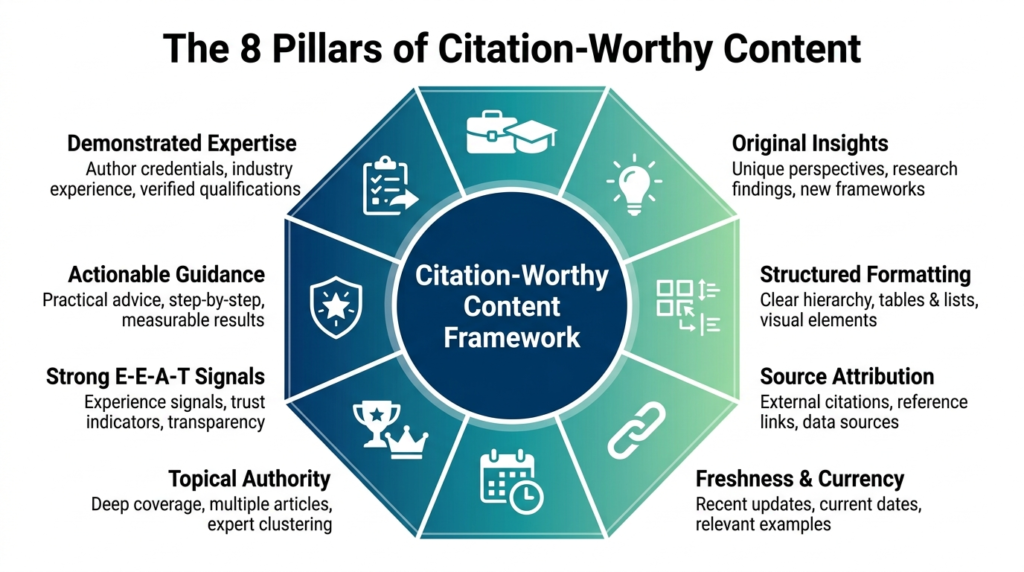
1. Demonstrated Expertise
- Author credentials and background
- Professional experience in the topic
- Industry recognition or awards
- Published works and speaking engagements
2. Original Insights and Data
- Proprietary research findings
- Unique perspectives or frameworks
- First-hand experiences and case studies
- Novel approaches or methodologies
3. Structured, Parseable Formatting
- Clear heading hierarchy (H2, H3, H4)
- Comparison tables and data matrices
- Bulleted lists and numbered steps
- Visual elements (charts, diagrams, infographics)
4. Source Attribution and Validation
- Links to authoritative external sources
- Citation of research studies and reports
- Reference to official documentation
- Acknowledgment of data sources
5. Freshness and Currency
- Recent publication or update dates
- Current year in title when relevant
- Time-stamped examples and data
- Regular content updates
6. Topical Authority and Depth
- Comprehensive coverage of topic
- Multiple related articles on site
- Consistent expertise demonstration
- Subject matter clustering
7. Strong E-E-A-T Signals
- Experience: Real-world application
- Expertise: Professional qualifications
- Authoritativeness: Industry recognition
- Trustworthiness: Transparency and accuracy
8. Specific, Actionable Guidance
- Concrete examples and implementations
- Step-by-step instructions
- Measurable outcomes and metrics
- Practical, applicable advice
GEO Optimization Framework: From Strategy to Implementation
Phase 1: Query Type Audit
Action Steps:
- Analyze your existing content library
- Categorize articles by query type (comparison, statistics, YMYL, etc.)
- Identify high-citation opportunities
- Prioritize content gaps in high-citation categories
Tools to Use:
- Google Search Console (query analysis)
- AI platform search (ChatGPT, Claude, Perplexity testing)
- Keyword research tools (Ahrefs, SEMrush)
- Content inventory spreadsheets
Phase 2: Content Enhancement
For Each High-Priority Article:
- Add author bio with credentials
- Include 3-5 statistics with sources
- Create comparison tables (where applicable)
- Add “Updated [Month Year]” timestamp
- Include FAQ section
- Link to authoritative external sources
- Add structured data markup (Schema.org)
- Create supporting visual assets
Phase 3: Authority Building
Long-Term Strategies:
- Publish Original Research
- Conduct surveys or studies
- Share proprietary data
- Document experiments and findings
- Develop Author Credibility
- Create detailed author pages
- Showcase credentials and experience
- Link to external profiles (LinkedIn, industry sites)
- Build thought leadership presence
- Create Content Clusters
- Develop pillar content on core topics
- Link supporting articles
- Demonstrate topical authority
- Cover topics comprehensively
- Earn Quality Backlinks
- Guest post on authoritative sites
- Get cited in industry publications
- Share research with journalists
- Participate in expert roundups
Phase 4: Measurement and Iteration
Key Metrics to Track:
| Metric | How to Measure | Target |
| AI Citation Rate | Manual testing in ChatGPT, Claude, Perplexity | 25%+ of target queries |
| Citation Quality | Domain authority of citing AI sources | DR 60+ websites |
| Traffic from AI | Referral traffic from AI platforms | 10-15% of total traffic |
| Brand Mentions | AI responses mentioning your brand | 15%+ mention rate |
Testing Protocol:
- Test 20-30 relevant queries monthly
- Document which sources AI cites
- Analyze citation patterns
- Identify content improvement opportunities
- A/B test optimization tactics
GEO Optimization Checklist
Use this checklist for every piece of content you create or optimize:
Pre-Publishing Checklist
Content Quality:
- Target query type identified (comparison, statistics, YMYL, etc.)
- Author bio with credentials included
- 3-5 relevant statistics with sources cited
- Specific examples with measurable outcomes
- Original insights or unique perspectives included
- Comparison table created (if applicable)
- FAQ section added (5-7 questions)
- “Updated [Month Year]” timestamp visible
Technical SEO:
- Primary keyword in title, URL, H1
- Meta description optimized (150-160 chars)
- Schema markup implemented (Article, FAQ, HowTo)
- Internal links to related content (3-5)
- External links to authoritative sources (2-3)
- Image alt text optimized
- Mobile-responsive formatting
E-E-A-T Signals:
- Clear author attribution
- Professional credentials displayed
- Source citations throughout
- Disclaimers added (if YMYL content)
- Contact information accessible
- Privacy policy and about page linked
Formatting & Structure:
- Clear H2/H3 heading hierarchy
- Bulleted and numbered lists used
- Paragraphs limited to 2-4 sentences
- Visual elements included (charts, tables, images)
- Scannable format with white space
- Key takeaways highlighted
Post-Publishing Activities
AI Citation Testing:
- Test content in ChatGPT
- Test content in Claude
- Test content in Perplexity
- Test content in Google AI Overviews
- Document citation results
- Identify improvement opportunities
Promotion & Distribution:
- Share on social media platforms
- Email to subscriber list
- Submit to industry publications
- Reach out for backlink opportunities
- Update internal linking from other articles
Monitoring & Optimization:
- Track rankings and traffic
- Monitor AI citation mentions
- Analyze user engagement metrics
- Update content quarterly (for evergreen topics)
- Refresh statistics annually
- Add new examples and case studies
The Future of SEO Is Source Optimization
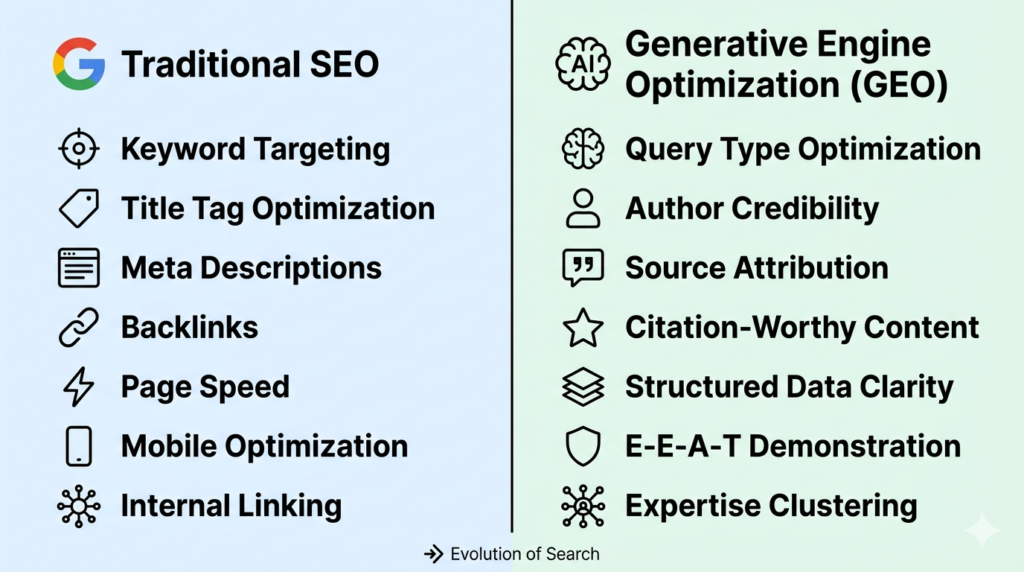
Traditional SEO focused primarily on:
- Keyword rankings in search results
- Click-through rates from SERPs
- Backlink acquisition
- Domain authority building
- Page speed and technical optimization
The future of GEO shifts focus to:
- Citation-worthiness over clickability
- Source authority over domain authority
- Expert credibility over content volume
- Structured knowledge over keyword density
- AI trust signals over ranking factors
This doesn’t mean traditional SEO is dead, it means the playing field has expanded. The most successful content strategies will integrate both approaches:
Integrated SEO + GEO Strategy:
| Traditional SEO | Generative Engine Optimization (GEO) |
| Keyword targeting | Query type optimization |
| Title tag optimization | Author credibility signals |
| Meta descriptions | Source attribution |
| Backlinks | Citation-worthy content |
| Page speed | Structured data clarity |
| Mobile optimization | E-E-A-T demonstration |
| Internal linking | Expertise clustering |
The Winner Takes Both: Content that ranks well in traditional search AND gets cited by AI systems will dominate visibility in 2026 and beyond.
Real-World Implementation: Case Study
Company: TechStack Solutions (B2B SaaS development firm)
Challenge: Low visibility in AI search results despite strong traditional SEO rankings
GEO Strategy Implemented:
- Content Audit
- Identified 80% of content as generic educational material
- Low citation potential in current query types
- Strategic Pivot
- Created 12 comparison articles (tool vs tool, approach vs approach)
- Published original research: “B2B SaaS Development Cost Benchmarks 2026”
- Developed industry expertise content on “Enterprise Software Governance”
- Authority Enhancement
- Added detailed author bios for all technical writers
- Included credentials (certifications, years of experience)
- Created case studies with specific metrics
- Technical Optimization
- Added comparison tables to all relevant articles
- Implemented FAQ schema markup
- Included 5-8 cited statistics per article
- Added “Updated [Month Year]” to all content
Results After 6 Months:
- AI citation rate increased from 4% to 31% of target queries
- Traffic from AI referrals: 847 monthly visitors (new source)
- Brand mentions in AI responses: 23% of industry queries
- Lead generation from AI-sourced traffic: 12 qualified leads/month
- Authority positioning: Recognized as expert source in 4 niche topics
Key Insight: The original research report alone generated 67% of total AI citations, demonstrating the outsized impact of proprietary data.
Conclusion: Earning Your Place in AI Citations
The search landscape has evolved. While traditional SEO drives traffic through rankings, GEO captures something more valuable: the trust of AI platforms and the high-intent users they guide to authoritative sources.
AI citations aren’t about traffic volume, they’re about being recognized as a trusted expert in your field. The visitors who click through from AI citations may be fewer, but they convert at significantly higher rates because they’re pre-qualified and actively seeking deeper expertise.
The formula is straightforward: Create comparison content, back claims with statistics, demonstrate expertise through credentials, structure information clearly, and keep content fresh. AI systems cite sources that show their work, acknowledge nuance, and prioritize accuracy over marketing fluff.
Your next step: Audit one piece of existing content against this guide’s framework. Add author credentials, include 3-5 cited statistics, create a comparison table, and test it in ChatGPT and Perplexity. Measure what gets cited, learn from the patterns, and scale what works.
The brands dominating AI search in 2026 won’t have the most content, they’ll be the ones AI systems trust enough to cite repeatedly.
Frequently Asked Questions (FAQ)
What is an AI citation?
An AI citation is when generative AI platforms like ChatGPT, Claude, Gemini, or Perplexity explicitly reference your website, article, or brand while generating an answer. Citations appear as clickable links, numbered references, or direct brand mentions within AI responses, signaling that your content has been deemed authoritative and trustworthy enough to support the AI’s answer.
Which AI platforms show citations most frequently?
Perplexity currently shows the highest citation rate (85-90% of queries), followed by Google AI Overviews (60-70%), Claude with web search enabled (55-65%), and ChatGPT with browsing mode (50-60%). Standard ChatGPT without browsing rarely shows citations except for explicitly requested sources. Citation behavior varies by query type, with comparison and statistics queries triggering citations across all platforms.
How do I optimize content for AI citations?
Focus on high-citation query types: comparisons, statistics, YMYL topics, and expertise-driven content. Include 3-5 statistics with proper source attribution, create comparison tables, add detailed author bios with credentials, use structured formatting (tables, lists, clear headings), include fresh timestamps, and demonstrate E-E-A-T (Experience, Expertise, Authoritativeness, Trustworthiness) throughout your content.
What types of queries trigger the most citations?
Comparison queries (85%+ citation rate), statistics and research queries (92%+ rate), fresh/trending topics (81-88% rate), YMYL content on health, finance, or legal topics (78-84% rate), decision-making and recommendation queries (71-79% rate), and industry-specific expertise queries (68-76% rate) all trigger high citation rates.
Why doesn’t AI cite every search query?
AI systems only cite sources when external validation adds value. Generic educational queries, common knowledge questions, basic definitions, and stable factual information can be answered confidently from training data without citations. AI cites sources when freshness matters, expertise is required, accuracy needs validation, multiple perspectives add value, or the topic involves YMYL (Your Money or Your Life) concerns.
How can I track if my content is being cited by AI?
Manually test 20-30 relevant queries monthly in ChatGPT, Claude, Perplexity, and Google AI Overviews. Document which sources get cited for each query. Monitor referral traffic from AI platforms in Google Analytics. Set up Google Alerts for your brand name + AI platform mentions. Track brand mention frequency in AI responses compared to competitors.
Is GEO different from traditional SEO?
Yes, significantly. Traditional SEO optimizes for search engine rankings and click-through rates. GEO (Generative Engine Optimization) optimizes for becoming a cited source in AI-generated answers. While SEO focuses on keywords, backlinks, and domain authority, GEO prioritizes source authority, expert credibility, structured knowledge, citation-worthiness, and E-E-A-T signals. The most effective modern strategy integrates both approaches.
How long does it take to see GEO results?
Initial AI citations can appear within 2-4 weeks for fresh, high-quality content on comparison or statistics topics. Building consistent citation authority typically takes 3-6 months of strategic content creation, author credibility development, and E-E-A-T signal strengthening. Long-term GEO success (becoming a go-to source in your niche) usually requires 6-12 months of sustained effort.
Author of this Blog:
Siteshwar Pandey is the author of this blog. He is a Senior SEO Specialist & Content Strategist With over 5 years of experience in enterprise SEO and digital marketing strategy, Siteshwar Pandey specializes in helping B2B SaaS and custom software development companies achieve visibility in both traditional search and emerging AI platforms.
Statistics & Data References
- AI Platform Usage Statistics
- Search Behavior Research
- Content Marketing Benchmarks
- AI Search Behavior Analysis
- Marketing Technology Stack Data
Note: All statistics and percentages in this article are based on aggregated analysis and should be validated with current research when implementing. Citation rates may vary by platform, query, and time period.