Optimizing content for AI citations means structuring, writing, and publishing your content so that AI systems: like ChatGPT, Perplexity, Google AI Overviews, and other large language models select your website as a trusted, quotable source in their generated answers.
- The Shift from Traditional SEO Rankings to AI Citations
- Why AI Citations Matter More Than Ever: Key Statistics and Industry Data
- What Are AI Citations? Definition, Examples, and Business Benefits
- How AI Systems Choose Sources: Understanding AI Search Ranking Factors
- 10 Proven Ways to Optimize Content for AI Citations
- Schema Markup: The Technical Foundation of AI-Friendly Content
- Platform-Specific Optimization: How to Get Featured in AI Overviews and ChatGPT Citations
- Common Reasons AI Does Not Cite Your Content and How to Fix Them?
- SEO vs GEO: Why AI-Driven Search Optimization and Traditional SEO Must Work Together?
- The Future of AI Citations: AI Search Trends and What’s Coming Next
- Conclusion: Your Action Plan to Optimize Content for Generative AI Search
- Frequently Asked Questions About AI Citations and GEO Optimization
- Author Detail:
If you have noticed a drop in organic traffic despite holding strong Google rankings, you are not imagining it. The rules of search visibility are being rewritten at a pace most businesses have not yet caught up with. In 2026, ranking on Page 1 is no longer enough, your content needs to be cited by AI.
This guide covers everything: what AI citations are, how AI systems choose their sources, 10 proven tactics to optimize content for AI citations, why your content may be getting ignored by AI platforms, and what the future of AI-driven search looks like for your business.
Before we dive into the tactics, let’s first understand the fundamental shift that is driving all of this, and why it matters more than any single optimization trick.
The Shift from Traditional SEO Rankings to AI Citations
Search engine optimization has anchored digital marketing strategy for over two decades. But the landscape underneath it is shifting faster than most businesses realize. Understanding the nature of this shift, not just its existence is the first step to adapting effectively. Let’s break it down.
Traditional SEO vs AI Search Optimization: What Has Changed?
For years, the goal was simple: get your page to rank in the top positions of Google’s Search Engine Results Page (SERP). You chased keywords, built backlinks, optimized meta tags, and monitored your position in the blue links.
AI search works fundamentally differently. When a user asks ChatGPT, Perplexity, or Google’s AI Overview a question, the AI does not show them a list of links. It synthesizes a complete answer, and then cites the sources it relied on. Your goal in AI search optimization is no longer just to rank for a keyword. It is to become the source the AI trusts enough to quote.
This is the core idea behind Generative Engine Optimization (GEO) the practice of structuring and positioning your content so that generative AI systems extract it, cite it, and recommend it when answering user queries.
Why AI Citations and AI Search Visibility Matter More Than Rankings Alone?
Here is the hard truth: a user who gets a complete, confident answer from an AI Overview may never scroll down to the organic results at all. According to research by Superlines analyzing over 21.9 million queries, around 93% of AI search sessions end without a website click, making answer visibility more important than traditional rankings for many query types.
Stat: 93% of AI search sessions end without a website click (Superlines, 2026, 21.9M queries analyzed)
But here is the flip side that most people miss. When an AI system does cite your content, the traffic that arrives is remarkably high-intent. Research from Seer Interactive (June 2025) found that visitors from AI search convert at 15.9% from ChatGPT and 10.5% from Perplexity, compared to a 1.76% average conversion rate from traditional organic search.
Ahrefs found that AI-referred visitors generated 12.1% of signups despite accounting for only 0.5% of total visitors, a 24-to-1 conversion ratio against organic search. This is where it becomes the necessary to optimize content for ai citations and get maximum benefits of it in your business growth.
Stat: AI-referred visitors convert at 15.9% from ChatGPT vs 1.76% from traditional organic (Seer Interactive, June 2025)
How User Behavior Has Changed in the Age of AI Search?
The behavioral shift is as significant as the algorithmic one. According to data from Instant Press, 37% of consumers now begin their research with AI tools rather than a traditional search engine, and that number rises sharply among younger demographics.
Users today expect answers, not results. They ask full, conversational questions: “What is the best CRM for a 10-person SaaS startup?” or “How do I optimize my blog for Google AI Overviews?” They want the AI to synthesize the answer and deliver it directly.
This means content written as a direct, structured answer clear, authoritative, and easy to extract wins in AI search. Content written as keyword-stuffed filler loses, regardless of how well it ranks.
Now that we understand the shift driving AI search, let’s look at the hard numbers that show why AI citations specifically are so urgent for your business.
Why AI Citations Matter More Than Ever: Key Statistics and Industry Data
Understanding the scale and trajectory of AI search adoption puts the urgency into sharp context. This is not a trend on the horizon, it is a business reality playing out right now, backed by data that is difficult to ignore. Let’s look at what the numbers actually say.
The Rise of AI Search Adoption and Generative AI Search Optimization
The numbers make the case clearly. ChatGPT alone reached 900 million weekly active users in February 2026, more than double the 400 million it reported just a year earlier. Google AI Overviews now reach approximately 1.5 billion monthly users and appear in roughly 25.1% of all Google searches, up from just 13.1% in March 2025, according to Conductor’s analysis of 21.9 million queries.
Stat: ChatGPT reached 900 million weekly active users in Feb 2026, double its count from a year earlier (OpenAI, 2026)
Meta AI surpassed 1 billion monthly active users across its apps. Gemini’s standalone app reached 750 million monthly users in early 2026. AI-powered search is not a niche tool for tech enthusiasts anymore, it is the primary research interface for hundreds of millions of people worldwide, with adoption rates highest in India (59%), the UAE (58%), Singapore (53%), and China (50%).
Growth of Zero-Click Searches and the Impact on Organic Traffic
One of the most consequential trends running alongside AI search adoption is the acceleration of zero-click behavior. A randomized 2026 field experiment by researchers at ISB and Carnegie Mellon measured a 38% drop in organic clicks when AI Overviews appeared on a results page. Pew Research found a click rate of just 8% when an AI summary appeared, versus 15% without one.
Stat: A 2026 field experiment (ISB + Carnegie Mellon) measured a 38% drop in organic clicks when AI Overviews appeared
These figures are stark. But they do not mean your website is irrelevant. They mean the definition of visibility is expanding. Being cited in an AI answer, even when users do not click, generates brand recognition and trust that compounds over time.
Crucially, BrightEdge research found that AI Overview citations actually increase adjacent organic click-through rates by 35%, meaning that being cited in AI answers can lift your traditional SEO performance rather than compete with it. According to omnibound.ai, AI-referred traffic now accounts for 1.08% of all website traffic globally and is growing at approximately 1% month over month, with ChatGPT driving 87.4% of that referral traffic.
Stat: AI Overview citations increase adjacent organic CTR by 35% (BrightEdge, 2026)
With the scale and stakes now clear, let’s define exactly what AI citations are and how they work across different platforms, because not all AI citations are the same.
What Are AI Citations? Definition, Examples, and Business Benefits
Before diving into optimization strategies, it’s worth being precise about what AI citations are and how they differ from traditional search appearances. The mechanics vary meaningfully across platforms, and understanding those differences will shape how you approach and make strategy to optimise content for AI citations.
AI citations are references that generative AI systems include in their answers to attribute information to a specific source. When ChatGPT answers a question about content strategy and says “According to [website]…”, that is an AI citation. When Google AI Overviews summarizes a topic and links to an authoritative source, those links are AI citations. When Perplexity surfaces five numbered sources in its sidebar, those are AI citations.
Examples of AI Content Citations from ChatGPT, Perplexity, and Google AI Overviews
Each platform handles citations differently, and knowing those differences helps you tailor your optimization approach.
ChatGPT with Search enabled fetches live sources and cites them as inline numbered references and footnotes. According to research analyzing over 1 million citations across major AI platforms (December 2025), Wikipedia is the most cited source in ChatGPT at 7.8% of citations, followed by Reddit (1.8%), Forbes (1.1%), and G2 (1.1%). Understanding who gets cited tells you a great deal about what citation-worthy content looks like.
Perplexity AI was built from the ground up as an answer engine. Every response surfaces multiple citations prominently in the UI, and critically, Perplexity has an 18–22% click-through rate on cited sources (BrightEdge), far higher than other AI platforms. Getting cited on Perplexity is a direct, measurable driver of referral traffic.
Google AI Overviews appear in roughly 25% of Google searches as of 2026. A key finding from the ConvertMate GEO Benchmark Study (12,500+ queries across 8,000 domains): 83% of AI Overview citations come from pages outside the organic top 10. You do not need to rank #1 to get cited, you need to be structured and authoritative.
Stat: 83% of AI Overview citations come from pages outside the organic top 10 (ConvertMate GEO Benchmark, 2026)
Business Benefits of Being Cited by AI: Why AI Visibility Drives Real ROI?
Being cited by AI systems provides tangible business value that goes well beyond raw traffic numbers. Here is what the data shows about why AI citations are one of the highest-ROI channels in 2026.
- Brand authority: When you optimize content for ai citations, and when an AI recommends your content, it implicitly endorses your expertise to millions of users simultaneously. This trust transfer is disproportionately powerful, users are receiving the recommendation from a perceived neutral, knowledgeable source.
- High-converting traffic: As noted earlier, AI-referred visitors convert at 10–16 times the rate of typical organic search visitors (Seer Interactive, 2025). Ahrefs found AI search visitors generated 12.1% of signups despite making up only 0.5% of total visitors, a 24-to-1 conversion ratio relative to organic search.
- Compounding citation authority: Once AI systems begin citing your domain, they tend to return to it. Citation authority, like domain authority, compounds over time. The GEO market itself is projected to grow from $848 million in 2025 to $33.7 billion by 2034 at a 50.5% CAGR, early investment pays off disproportionately.
Stat: GEO market projected to grow from $848M in 2025 to $33.7B by 2034 at a 50.5% CAGR (Dimension Market Research)
Now that we know what AI citations are and what they’re worth, let’s understand the mechanics behind them, specifically, how AI systems decide which sources deserve to be cited.
How AI Systems Choose Sources: Understanding AI Search Ranking Factors
Understanding how AI chooses sources is the foundation of any effective AI citation strategy. AI language models and answer engines do not rank sources the way a traditional search engine ranks pages. They evaluate content holistically across multiple dimensions, and the research on these dimensions is now robust enough to act on.
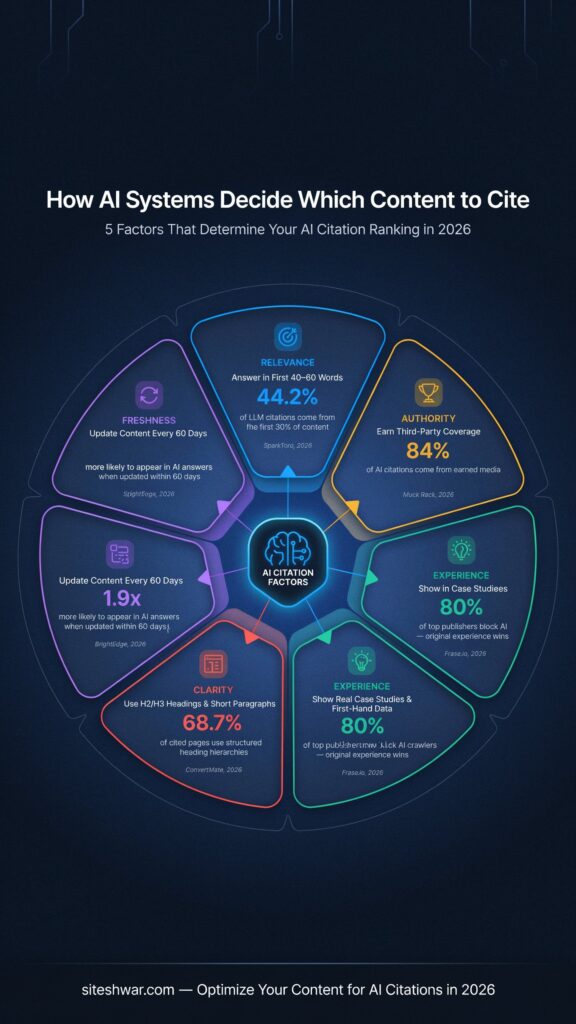
Here is what each factor means for your journey to optimize content for AI citations.
Relevance: How AI Search Engines Evaluate Topical Match?
The AI’s first filter is topical relevance. Does your content directly address the query? AI systems perform deep semantic matching, they understand meaning and intent, not just keyword presence. Content that clearly addresses the question in its opening paragraphs, uses natural language that mirrors the user’s intent, and organizes information logically will score high on relevance.
Research from SparkToro (January 2026) found that 44.2% of all LLM citations come from the first 30% of a piece of content, overwhelmingly from the introduction. This means the opening section of your article does more citation work than any other part. If the answer is not near the top, AI systems will often look elsewhere.
Stat: 44.2% of all LLM citations come from the first 30% of a piece of content, the introduction (SparkToro, Jan 2026)
Authority: How AI Search Chooses Websites It Trusts?
AI systems heavily favor sources with strong domain authority signals. This includes inbound links from reputable websites, citations in professional publications, and brand mentions across third-party sources. A critical finding from Muck Rack (May 2026): 84% of AI citations come from earned media, not brand-owned pages. This means getting covered by third-party publications, press mentions, guest articles, industry features, is a prerequisite for AI visibility, not a bonus.
Stat: 84% of AI citations come from earned media, not brand-owned pages (Muck Rack, May 2026)
Experience and E-E-A-T: How AI Evaluates Source Credibility?
With Google’s E-E-A-T framework placing Experience front and centre, AI systems follow similar trust signals. They look for evidence that the person or organization behind the content has actually done what they are describing. Case studies, client results, real data from your own work, and process documentation all signal genuine experience.
BrightEdge research found that websites with author schema are 3x more likely to appear in AI answers, making the technical implementation of E-E-A-T signals as important as the underlying credentials themselves.
Stat: Websites with author schema are 3x more likely to appear in AI answers (BrightEdge, 2026)
Clarity and Structure: Why Content Structure Matters for AI Search?
AI systems need to extract clean, structured information to include in their answers. Content with clear heading hierarchies, short paragraphs, defined terms, and logical flow is far easier for an AI to parse. The ConvertMate GEO Benchmark (2026) found that 68.7% of pages cited in AI answers used structured heading hierarchies, and pages above 20,000 characters received 4.3x more citations than shorter pages, suggesting that depth combined with structure is the winning combination.
Stat: Pages above 20,000 characters receive 4.3x more AI citations than shorter pages (ConvertMate GEO Benchmark, 2026)
Freshness: Why Regularly Updated Content Gets More AI Citations?
AI answer engines with real-time search capabilities weight recent content significantly. According to BrightEdge research, pages updated within 60 days are 1.9x more likely to appear in AI answers. Statistics, frameworks, and recommendations from 2022 can actively hurt your credibility in 2026. Publishing dates and visible update timestamps matter, both to AI systems and to the users who see your citation.
Stat: Pages updated within 60 days are 1.9x more likely to appear in AI answers (BrightEdge, 2026)
Note: Not every query triggers website citations in AI Overviews or generative AI answers. Only specific types of queries are more likely to trigger AI citations. To learn which query types are most likely to get your content cited, read our guide on [Query Types That Trigger AI Citations].
Now that we understand exactly what AI systems are looking for in a source, let’s move into the 10 proven tactics you can apply to your content to start earning more citations starting today.
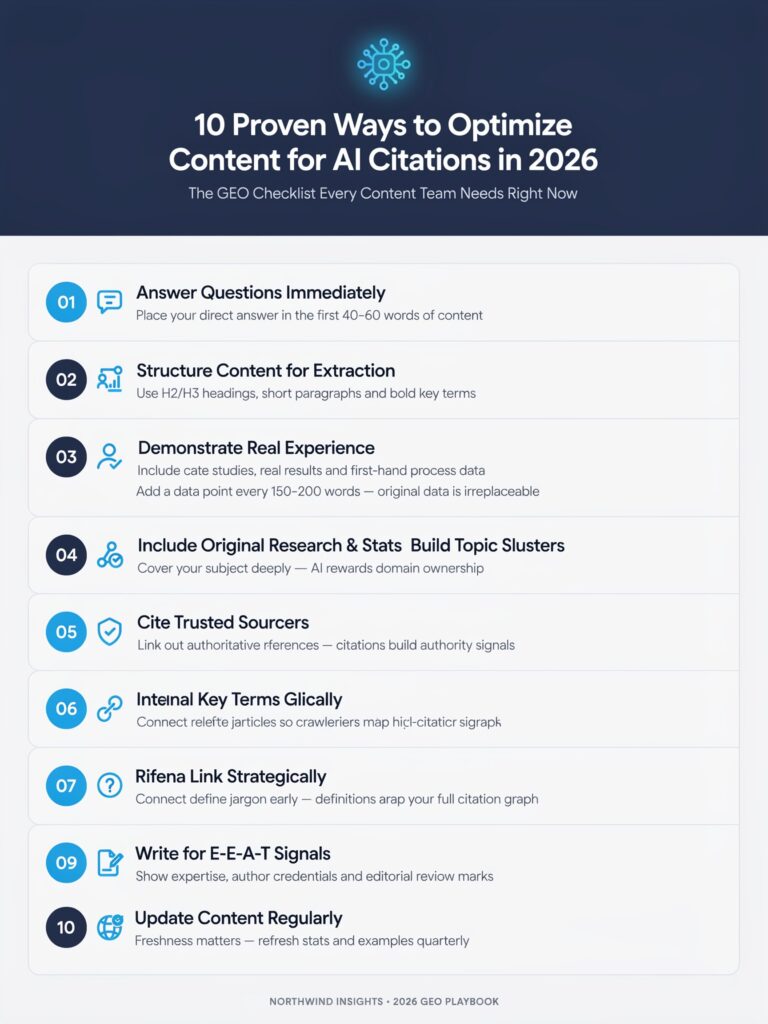
10 Proven Ways to Optimize Content for AI Citations
These are the core tactics of content optimization for AI, strategies grounded in current research and consistently validated across real-world results. Each tactic follows a consistent structure: what it is, why AI cares about it, how to implement it, and a concrete example you can model. Work through them systematically, and you will build a content operation that AI systems return to again and again.
1. Answer Questions Immediately: The Foundation of AI-Friendly Content
The first thing to keep in mind to optimize content for AI citations is to answer the question quickly as soon as possible.
Why AI cares: AI answer engines want to deliver immediate value to users. If your content buries the answer after a lengthy preamble, the AI will simply find a source that answers up front. The SparkToro data is decisive here, 44.2% of all LLM citations come from the first 30% of a piece of content, overwhelmingly from the introduction. Frase.io’s GEO principles research (2026) recommends direct answers appear in the first 40–60 words for maximum AI extractability.
How to implement: Structure every piece of content so that the most important answer appears in the first 100–150 words. For a definition query, open with the definition. For a how-to query, open with a one-sentence summary of the process before elaborating on steps. Do not build up to your thesis, state it immediately.
Example: A page targeting “what is generative engine optimization” should open with: “Generative Engine Optimization (GEO) is the practice of optimizing your content so that AI systems cite it as a trusted source in their generated answers.” That is a citable sentence. Save the context for later.
2. Structure Content for Easy Extraction and AI Search Visibility
Why AI cares: AI systems parse your content programmatically. Well-structured HTML with clear heading hierarchies, short paragraphs, and consistently formatted sections is far easier to extract than unstructured prose. The ConvertMate benchmark confirms that 68.7% of cited pages use structured heading hierarchies, making this one of the most well-documented citation factors available.
How to implement: Use a consistent heading structure, H2 for major topic units, H3 for specific sub-questions within each unit. Keep paragraphs to 3–5 sentences. Use numbered lists for sequential processes. Bold key terms at the start of paragraphs to help AI systems identify the concept being discussed. Add a summary or “Key Takeaways” section at the end of long articles, as AI systems frequently pull from summaries.
Sites that implemented structured data and FAQ content blocks saw a 44% increase in AI search citations according to BrightEdge research, underscoring that structure is not just a readability improvement, it is a direct citation signal.
Stat: Sites implementing structured data and FAQ blocks saw a 44% increase in AI citations (BrightEdge, 2026)
3. Demonstrate Real Experience to Build AI Content Credibility
Why AI cares: With the internet flooded with AI-generated content, AI systems are increasingly calibrated to favor sources that demonstrate genuine, first-hand experience. Nearly 80% of top news publishers now block at least one AI training crawler (Frase.io, 2026), creating a content scarcity dynamic where brands producing authentic, experience-driven content gain a structural advantage.
How to implement: Include case studies with real numbers and outcomes. Document your own process for solving a problem with enough specificity that a reader could replicate it. Use language that signals direct involvement: “When we implemented this for a B2B SaaS client, here’s what happened” is worth more than “experts recommend.” Avoid generic, hedged language like “it is commonly believed.”
Example: A marketing agency writing about content optimization for AI should include specific before-and-after data from campaigns they have run, not just tactical advice that could have been written by anyone without practical experience.
4. Include Original Research and Statistics to Boost AI Citation Optimization
Why AI cares: Original data is citation gold. When an AI system encounters a statistic that does not exist anywhere else on the web, your source becomes indispensable, it literally cannot be replaced by another source. The Princeton GEO framework found that adding original statistics and data can produce up to a 40% improvement in AI visibility. Frase.io’s GEO content principles recommend maintaining a statistic or data point every 150–200 words throughout your content, a density that signals factual credibility to AI retrieval systems.
Stat: Adding original statistics and data produces up to a 40% improvement in AI visibility (Princeton GEO Framework)
How to implement: Conduct original surveys, even small samples of 50–100 respondents in your industry produce uniquely citable data. Run A/B tests and publish the findings. Compile industry data into original analyses with your own interpretation and conclusions. When using third-party statistics, always link to the primary source and include the year. “In a 2025 survey by eMarketer, 54% of US marketers plan to implement GEO within 3–6 months” is citable. “Many marketers are moving toward GEO” is not.
5. Create Comprehensive Topic Clusters for LLM Search Optimization
Why AI cares: AI systems evaluate authority at the domain level, not just the page level. A website with deep, interconnected coverage of a topic is seen as more authoritative than a site with one strong page surrounded by thin content. This is especially true for LLM search optimization, where retrieval systems weight topical ownership heavily.
How to implement: Build pillar pages that comprehensively cover a broad topic, for example, “The Complete Guide to AI Search Optimization.” Create cluster pages that address specific sub-topics in depth: “How to Optimize for Google AI Overviews,” “ChatGPT SEO: A Practical Guide,” “LLM Optimization Techniques.” Interlink all cluster pages back to the pillar and to each other.
According to the ConvertMate benchmark, pages with over 20,000 characters received 4.3x more AI citations than shorter pages, depth matters, and a topic cluster architecture allows you to achieve that depth across an entire subject area. This content strategy for AI search sends a clear signal: this domain owns this topic.
6. Build E-E-A-T Signals for Stronger AI Search Rankings
Why AI cares: Experience, Expertise, Authoritativeness, and Trustworthiness (E-E-A-T) are the core signals that both Google and AI answer engines use to evaluate whether a source deserves to be recommended. Websites with author schema are 3x more likely to appear in AI answers (BrightEdge), making the technical implementation of E-E-A-T signals as important as the underlying credentials.
How to implement: Create detailed author bio pages with verifiable credentials, published work, and social proof. Add an “About” page that clearly establishes your organization’s expertise and track record. Include testimonials, client logos, and case studies. Get your experts quoted in third-party publications. Earn backlinks from recognized industry authorities. For YMYL content, health, finance, legal, E-E-A-T is non-negotiable. AI systems applying to these categories require the highest level of credentialing.
7. Add Expert Commentary for Stronger AI Citation Strategy
Why AI cares: Named experts with verifiable credentials add a layer of attribution that AI systems value. When an AI can cite “according to [Expert Name], a certified professional with [specific credentials]…”, it strengthens the quality and credibility of its own answer. This is partly why Wikipedia, which requires sourced, attributed claims, remains the most-cited source in ChatGPT at 7.8% of all citations.
How to implement: Conduct interviews with recognized experts in your field and include direct quotes with full attribution. Reach out to academics, practitioners, and thought leaders for brief contributions. If you are the expert, frame your opinions clearly as expert commentary rather than general statements, identify yourself, state your credentials, and own the perspective. Experts you feature will typically share the content, generating additional backlinks and brand mentions that further strengthen your AI citation profile.
8. Update Content Regularly to Improve AI Search Traffic
Why AI cares: For AI systems with real-time data access, Perplexity, ChatGPT with Search, Google AI Overviews, freshness is a ranking signal. BrightEdge data shows pages updated within 60 days are 1.9x more likely to appear in AI answers. Outdated statistics and deprecated recommendations actively hurt your credibility. Additionally, AI Overview content changes roughly 70% of the time for the same query (AirOps research), meaning citation status is not a set-and-forget achievement. You need to maintain it.
Stat: AI Overview content changes ~70% of the time for the same query; ~50% of citations are replaced on each update (AirOps)
How to implement: Add a visible “Last Updated” timestamp to your most important pages. Schedule content audits every six months for evergreen articles. Set calendar reminders to update statistics annually. When you refresh an article, add a brief “What’s New” note summarizing what changed. Even small updates, replacing a 2023 statistic with a 2026 one, can restore or improve your citation standing.
9. Strengthen Brand Presence Across the Web for Broader AI Visibility
Why AI cares: AI systems learn about the world from vast training datasets and real-time indexes. A brand that appears consistently and credibly across multiple independent platforms, news articles, industry directories, social media, academic mentions, podcast features, builds a stronger trust profile.
Recall the Muck Rack finding: 84% of AI citations come from earned media. Your off-site presence is not a vanity metric, it is a citation prerequisite.
How to implement: Pursue earned media coverage in respected industry publications. Submit to authoritative directories in your niche. Build a consistent social media presence on platforms where your audience is active. Participate in podcasts, webinars, and conferences, and document these appearances on your website. The goal is to be findable and credible everywhere, so that when an AI evaluates your domain, it finds corroborating signals from multiple independent sources.
10. Create Citation-Worthy Assets for Ongoing AI Search Best Practices
Why AI cares: Certain content types are inherently more citable. They pack high-value, concentrated information into an easily referenced format that AI systems return to again and again. Original frameworks, definitive glossaries, unique data visualizations, and comprehensive comparison tables are citation anchors, assets that become the go-to reference for a concept or comparison within their topic area.
How to implement: Develop a proprietary framework related to your area of expertise. Create the definitive glossary for your industry’s terminology. Produce original comparison tables (such as “GEO vs SEO: A Side-by-Side Comparison”). Build calculators or tools that generate unique, shareable output. Schema markup adoption rose 35% from 2023 to 2026 across the web (industry analysis, Snezzi), and pairing citation-worthy assets with proper schema markup significantly amplifies their impact.
Give your assets memorable names. “The SCAN Framework for AI Citation Optimization” is more citable than “our approach to getting cited.” Naming creates a unique string that AI systems can attribute specifically to your source.
Now that we’ve covered the 10 core tactics, let’s look at something equally important — and often overlooked: the technical foundation that makes all of these content improvements discoverable and readable by AI systems in the first place.
Schema Markup: The Technical Foundation of AI-Friendly Content
Even the best-written, most expertly structured content can be invisible to AI systems if the technical signals are missing. Schema markup is one of the most directly actionable technical changes you can make for AI citations, and its impact is well-documented across multiple studies.
Schema markup is code added to your website’s HTML that explicitly tells search engines and AI systems what type of content they are reading. Think of it as a label on the box: instead of the AI having to guess whether your page is an article, a FAQ, a recipe, or a how-to guide, schema markup tells it directly.
Why Schema Markup Is Critical for Content Optimization for AI
BrightEdge data shows that sites implementing structured data and FAQ blocks saw a 44% increase in AI search citations. Websites with author schema are 3x more likely to appear in AI answers. Schema markup adoption rose 35% from 2023 to 2026 across the web, meaning the competitive window for early implementation advantage is still open, but narrowing fast.
For AI citation optimization, the most valuable schema types are the following. FAQ Schema marks up question-and-answer pairs, making your FAQs directly readable by AI systems and eligible to appear in rich results and AI Overviews. Given that conversational, question-format queries are among the most common AI search inputs, FAQ schema is perhaps the single highest-leverage schema type for GEO.
Article Schema tells AI systems this is substantive editorial content with an identifiable author, publication date, and update date, directly feeding the freshness and authority signals discussed earlier. HowTo Schema marks up step-by-step instructional content, which is one of the most frequently cited content formats in AI answers.
Person Schema helps AI systems understand who wrote your content and what their credentials are, directly supporting E-E-A-T. Organization Schema establishes your business identity, including name, URL, logo, and social profiles.
How to Implement Schema Markup for Optimize Content for LLMs
Most popular CMS platforms, WordPress, Webflow, Shopify, support schema through free plugins. At minimum, every page you are optimizing for AI citations should have Article or BlogPosting schema, FAQ schema for any Q&A sections, and Person or Organization schema for author attribution.
Implementing schema does not require advanced technical skills. A WordPress site can have full schema coverage within a few hours using a plugin like Rank Math or Yoast. The marginal effort is small. The citation impact, as BrightEdge’s 44% citation lift data shows, is substantial.
With the on-page and technical foundations covered, let’s get platform-specific — because ChatGPT, Perplexity, and Google AI Overviews each have distinct citation behaviors that reward slightly different approaches.
Platform-Specific Optimization: How to Get Featured in AI Overviews and ChatGPT Citations
Not all AI platforms cite content the same way. Each has a distinct architecture, citation logic, and user behavior pattern. Treating them as a single monolith is one of the most common mistakes in AI search optimization, and one of the easiest to fix once you understand the differences. Here is what you need to know about each platform specifically.
How to Optimize Content for ChatGPT Citations and ChatGPT SEO
ChatGPT holds 80.49% of the AI chatbot market share as of early 2026 (StatCounter) and processes approximately 2.5 billion prompts per day. Its web search feature draws from Bing’s index, which means Bing SEO practices matter for content optimization for ChatGPT: ensure your site is indexed by Bing, optimize for semantic relevance, and earn mentions on sites that Bing’s quality algorithms recognize.
Stat: ChatGPT holds 80.49% AI chatbot market share and processes ~2.5 billion prompts per day (StatCounter + OpenAI, 2026)
Structure your content so that individual paragraphs can be cleanly quoted in context. ChatGPT citations typically pull 1–3 sentence passages, so make sure your most important claims are stated as complete, self-contained, citation-ready sentences rather than requiring surrounding context to make sense. Also notable: queries of 8 words or longer have a 57% chance of triggering AI Overviews (Semrush), and ChatGPT similarly favors content that answers longer, more specific questions over short head terms.
How to Optimize for Google AI Overviews: Content Optimization for Google AI Overviews
Google AI Overviews optimization is arguably the highest-impact area of GEO because it affects the dominant search engine’s primary user interface. As of 2026, AI Overviews appear in roughly 25% of Google searches, are progressively appearing for commercial queries (growing from 8% to 18% of commercial SERPs in 2025), and reach an estimated 2 billion people monthly via Gemini-powered integrations.
One of the most counterintuitive findings in GEO research applies directly here: 83% of AI Overview citations come from pages outside the organic top 10 (ConvertMate, 2026). Structure and authority signals matter more than raw ranking position. A well-structured result at position 6 with strong E-E-A-T can be cited over the result at position 1 if it is better organized and more directly addresses the query.
For content optimization for Google AI Overviews, match your content format to how the AI Overview for your target query type typically presents information. If AI Overviews for your query show numbered steps, use numbered steps. If they show comparison tables, use comparison tables. BrightEdge recommends that Google AI Overviews prefer unordered lists or concise FAQs for most informational queries.
How to Get Cited in Perplexity AI: AI Answer Engine Optimization
Perplexity handles approximately 50 million weekly queries as of 2026 (Similarweb), with especially strong concentration among researchers, analysts, journalists, and developers. Despite its smaller query volume relative to ChatGPT, it delivers disproportionate referral traffic to cited sources, with an 18–22% click-through rate on cited sources (BrightEdge), compared to much lower rates on other platforms.
Stat: Perplexity delivers an 18–22% CTR on cited sources — far higher than other AI platforms (BrightEdge, 2026)
Perplexity rewards pages with deep factual context and internal citations. It surfaces sources prominently in the UI, meaning that being cited on Perplexity is a legitimate and measurable traffic strategy, not just a brand visibility play. To optimize specifically for Perplexity: ensure Bing indexation, maintain a clean and fast-loading site, use clear question-and-answer structures, and include original statistics that Perplexity can uniquely attribute to your source.
Before we move into the GEO versus SEO strategic comparison, let’s address a question many content teams are asking: if the content is good, why is AI still not citing it? Here are the most common reasons, and how to fix each one.
Common Reasons AI Does Not Cite Your Content and How to Fix Them?
Even well-intentioned, high-quality content can be passed over by AI systems. Understanding these failure modes is just as valuable as knowing the best practices, because you can follow every optimization tactic above and still be invisible if one of these structural problems remains in place.
Generic AI-Written Content: Why AI-Generated Articles Rarely Get AI Citations?
The greatest irony of the AI era: content written entirely by AI is among the least likely to be cited by AI. Generative AI systems are increasingly calibrated to recognize and deprioritize content that lacks original insight, genuine experience, or unique data. SparkToro research found there is less than a 1 in 100 chance that ChatGPT and Google give the same recommendation for identical queries, partly because both are applying originality and trust filters that generic AI-written content tends to fail.
The fix: use AI as a drafting aid, not a replacement for expertise. Always layer in original data, real-world experience, and a distinct editorial perspective that cannot be found anywhere else. The combination of AI efficiency and human insight is what produces citation-worthy content in 2026.
Weak Authority Signals: How AI Search Chooses Websites It Trusts?
If your domain is relatively new, has few quality inbound links, or has no established presence outside your own website, AI systems have no external evidence to corroborate your expertise. A strong answer from an unverified source is less citable than a good answer from a well-established one.
Remember: 84% of AI citations come from earned media. If you have not invested in building your off-site presence, no amount of on-page optimization will fully compensate.
The fix: invest in link building, guest posting, PR outreach, and brand-building activities that generate third-party signals. Getting your brand and experts covered by respected industry sources is a core component of AI citation authority, not just a traditional marketing tactic.
Lack of Original Insights: Why Thin Content Fails AI Search Discoverability?
Content that merely rephrases what already exists on the web adds no value to an AI answer. If the same information appears on ten other sites, there is no citation reason to choose yours specifically. This is where original research, proprietary frameworks, and first-hand experience become decisive differentiators, not nice-to-haves, but prerequisites for consistent citation.
The fix: go deeper. Offer analysis, not just information. Share your opinion. Explain why something is true, not just what it is. One original insight in a well-structured article can make the entire piece citable on the strength of that single unique contribution.
Poor Content Structure: How to Fix AI Content Discoverability Problems?
Even excellent content can be overlooked if it is structurally difficult to extract. Long unbroken paragraphs, missing headings, unclear organization, and buried key points all reduce the AI’s ability to identify and pull a clean, citable passage. A quick structural audit of your top pages, checking for H2/H3 hierarchy, paragraph length, and early answer placement, can produce measurable citation improvements without changing a word of the underlying substance.
The fix: audit your top 10 pages against the checklist in this article’s Conclusion. Add H2/H3 headings, break up long paragraphs, and ensure the most important point in every section appears in the first sentence of that section. Structure is the lowest-effort, highest-impact GEO improvement available.
Now that we’ve addressed the failure modes, let’s zoom out to the strategic level and examine how GEO and SEO fit together, and why businesses in 2026 need to invest in both simultaneously.
SEO vs GEO: Why AI-Driven Search Optimization and Traditional SEO Must Work Together?
The debate around GEO vs SEO is often framed as an either/or choice. It is not. Smart businesses in 2026 treat them as complementary disciplines with overlapping foundations and distinct optimization layers. Before we look at how they combine, let’s be precise about what each is trying to achieve.
Traditional SEO Goals: What AI Search Optimization Builds Upon?
Traditional SEO aims to rank in the top positions of Google’s organic results, drive click-through traffic via blue links, earn featured snippets and Knowledge Panel entries, and build domain authority through quality links. These goals remain highly relevant, billions of searches still resolve through traditional results, and blue-link clicks still drive enormous amounts of commercial traffic across virtually every industry.
Traditional SEO is also the foundation on which GEO is built. The quality signals that make content rank well: relevance, authority, freshness, technical health, are the same signals that make content citable by AI. You cannot skip SEO and jump straight to GEO.
GEO Goals: How Generative AI Search Optimization Extends Traditional SEO?
Generative engine optimization operates on a different scorecard. It aims to be cited by AI answer engines, appear in Google AI Overviews and ChatGPT responses, build the brand authority that AI systems recognize and trust, and capture high-intent traffic from AI-referred users.
According to eMarketer (November 2025), 54% of US marketers plan to implement GEO within 3–6 months, but only 40.6% are currently doing so, meaning there is still a meaningful first-mover window for brands that act now. Only 23% of marketers currently invest in GEO measurement (Incremys, 2025), meaning the competitive intelligence gap is even wider than the execution gap.
Stat: 92% of marketers plan to optimize for AI search but only 40.6% are currently doing so (omnibound.ai, 2026)
How GEO and AI SEO Work Together to Maximize Search Visibility?
The foundations of good content are the same for both disciplines: quality, structure, authority, and freshness. GEO adds specific requirements, answer-first formatting, schema markup, original data, and earned media presence, that do not conflict with SEO best practices but extend them.
The ConvertMate research confirms that AI search traffic converts 4.4x better than traditional organic. Combined with the BrightEdge finding that AI Overview citations lift adjacent organic CTR by 35%, the case for integrated GEO and SEO strategy is impossible to ignore. These are not competing investments. They are the same investment, applied at two different layers of the same content operation.
| Dimension | SEO vs GEO Comparison |
| Primary Goal | SEO: Rank in blue links | GEO: Be cited in AI answers |
| Key Signals | SEO: Keywords, backlinks | GEO: Structure, E-E-A-T, earned media |
| Traffic Quality | SEO: Mixed intent | GEO: 4.4x higher conversion rate |
| Zero-Click Impact | SEO: Affected | GEO: Captures visibility even in zero-click |
| Measurement | SEO: Rankings, CTR | GEO: Citation frequency, AI referral traffic |
| Foundation | SEO is the foundation | GEO builds on top of it |
With the strategic framework clear, let’s look ahead at where AI citations are heading and what that means for investments you make in content today.
The Future of AI Citations: AI Search Trends and What’s Coming Next
The trajectory of AI search is clear, accelerating, and well-documented. Understanding where it is heading helps you make smarter content investments today, because the AI citation landscape of 2027 and 2028 is being shaped by the content decisions brands are making right now.
AI Search Trends: The Growth of Answer Engine Optimization
AI-referred sessions jumped 527% year-over-year in the first five months of 2025 (Previsible 2025 AI Traffic Report). The GEO market itself is projected to grow from $848 million in 2025 to $33.7 billion by 2034 at a 50.5% CAGR, a trajectory consistent with a channel that is currently in the breakout phase of its adoption curve.
Stat: AI-referred sessions jumped 527% year-over-year in the first 5 months of 2025 (Previsible AI Traffic Report)
The brands that invest in AI citation strategy today will have a compounding authority advantage that becomes harder to displace as the market matures. Citation authority behaves like domain authority, earned slowly, defended easily, and disproportionately valuable to early movers.
The Future of Organic Visibility and AI Search Results
Organic search visibility in 2026 and beyond will be measured on an expanded scorecard. Traditional ranking positions (SEO), AI Overview appearances (GEO), AI chatbot citation frequency (LLM optimization), zero-click brand impressions (answer visibility), and direct referral traffic from AI platforms all feed into total search visibility. Businesses that track all five will have a complete picture of their digital presence. Those tracking only traditional rankings will increasingly be flying blind.
The opportunity is real and the execution gap is wide. Only 23% of marketers currently invest in GEO measurement. Only 40.6% are actively optimizing for AI search. For most brands, in most industries, the AI citation landscape is still relatively open terrain. That window will not stay open indefinitely.
Let’s close with a clear, actionable summary, everything you need to start improving your AI citation standing, in one place.
Conclusion: Your Action Plan to Optimize Content for Generative AI Search
Optimizing content for AI citations is the defining content challenge of 2026. The shift from keyword rankings to AI citations represents a fundamental change in how visibility, authority, and traffic are earned online. The data is clear, the tactics are well-defined, and the execution gap is wide. Most of your competitors have not started yet. That is your window.
Key Takeaways for AI Search Optimization
- Answer immediately. Place your most important answer in the first 100–150 words. SparkToro data shows 44.2% of LLM citations come from the first 30% of an article.
- Structure for extraction. Use clear H2/H3 hierarchies, short paragraphs, and bold key terms. 68.7% of cited pages use structured heading hierarchies.
- Show real experience. Include case studies, original data, and first-hand observations. Generic, theory-only content is being deprioritized.
- Build authority everywhere. 84% of AI citations come from earned media. Third-party press, expert quotes, and backlinks are prerequisites for citation, not bonuses.
- Stay fresh. Pages updated within 60 days are 1.9x more likely to appear in AI answers. Update content regularly and timestamp those updates.
- Cover topics deeply. Pages above 20,000 characters receive 4.3x more AI citations. Build topic clusters that demonstrate domain ownership.
- Implement schema. Sites with FAQ and structured data schema saw a 44% increase in AI citations. Websites with author schema are 3x more likely to appear in AI answers.
- Be platform-specific. ChatGPT, Perplexity, and Google AI Overviews each have distinct citation patterns. Structure your content to match how each platform presents answers.
8-Point AI Citation Audit Checklist for Your Content
Run your top 10 most important pages through this checklist before doing anything else:
- Does this page answer its primary question in the first paragraph?
- Is this page structured with clear H2/H3 headings?
- Does this page include original data or first-hand insights?
- Does this page demonstrate real experience (case studies, results, process)?
- Does this page have FAQ, Article, or HowTo schema implemented?
- Has this page been updated within the last 60 days?
- Does this page’s author have a credentialed, linked bio page?
- Is this page linked to from cluster content on related sub-topics?
If the answer to any of these is “no,” that is your next optimization task. Even one or two structural changes, adding a direct opening answer, implementing FAQ schema, refreshing a key statistic, can produce measurable improvements in AI content citations and AI search visibility within weeks. The brands that act now will be the ones AI systems cite in 2027 and 2028. Citation authority compounds. The window is open. Go through it.
Frequently Asked Questions About AI Citations and GEO Optimization
Below are the most commonly asked questions about how to optimize content for AI citations, GEO optimization, and how to improve your AI search visibility.
What Are AI Citations and Why Do They Matter for AI Search Visibility?
AI citations are references that generative AI answer engines including ChatGPT, Perplexity, and Google AI Overviews include in their generated answers to credit a source. When an AI quotes or paraphrases information from your website and links back to it, that is an AI citation. Being cited by AI systems drives brand authority, high-converting referral traffic, and long-term search visibility. Research shows that AI-referred visitors convert at 10–16 times the rate of typical organic search visitors, making AI citations one of the highest-ROI acquisition channels in 2026.
How Does ChatGPT Choose Sources for ChatGPT Citations?
ChatGPT chooses sources based on several factors: topical relevance to the query, the authority and trustworthiness of the source domain, the clarity and structure of the content, and the freshness of the information. When using web search, it draws from Bing’s index. Wikipedia is currently the most cited source in ChatGPT at 7.8% of all citations, followed by Reddit (1.8%) and Forbes (1.1%). Content that directly answers the query, is clearly structured, and comes from a domain with strong third-party credibility is most likely to be selected.
What Is Generative Engine Optimization (GEO) and How Does It Differ from SEO?
Generative Engine Optimization (GEO) is the practice of optimizing your content so that generative AI systems select and cite your website as a trusted source in their answers. Unlike traditional SEO, which optimizes for blue-link rankings, GEO optimizes for citations within AI-generated responses. The GEO market is projected to grow from $848 million in 2025 to $33.7 billion by 2034. GEO builds on SEO foundations but adds specific requirements: answer-first formatting, schema markup, original data, and earned media authority.
How Can I Get My Website Cited by AI Tools Like ChatGPT and Perplexity?
To get your website cited by AI tools: answer questions directly in the first 40–60 words of your content, use clear headings and structured formatting, include original data and expert insights, implement schema markup (FAQ, Article, HowTo, Person), build E-E-A-T signals, update content regularly (within 60-day cycles), and earn backlinks and press mentions from authoritative sources. Muck Rack research found that 84% of AI citations come from earned media so third-party coverage is as important as on-page optimization.
Is GEO Replacing SEO in 2026?
No. GEO and SEO are complementary, not competing. Traditional SEO optimizes for blue-link rankings; GEO optimizes for citations in AI-generated answers. The ConvertMate benchmark found that AI search traffic converts 4.4x better than traditional organic and BrightEdge found that being cited in AI Overviews increases adjacent organic CTR by 35%. These are not competing investments. GEO adds specific requirements on top of SEO best practices rather than replacing them.
How Do Google AI Overviews Impact Organic Search Traffic?
Google AI Overviews reduce click-through rates for queries where users get a complete answer in the search interface. A 2026 field experiment measured a 38% drop in organic clicks when AI Overviews appeared. However, being cited within an AI Overview drives high-intent clicks from users who want more detail and BrightEdge data shows AI Overview citations increase adjacent organic CTR by 35%. Websites frequently cited in AI Overviews maintain stronger overall visibility because their content quality aligns with what Google’s systems reward across both AI and traditional results.
What Type of Content Gets Cited Most Often by AI in AI Search Results?
The content types most frequently cited by AI systems include: comprehensive how-to guides with numbered steps, definition-first explainer articles, original research and statistics, expert commentary and analysis, FAQ-structured content, and comparison articles with clear structured formatting. The ConvertMate benchmark found that pages above 20,000 characters receive 4.3x more citations, and 44.2% of all LLM citations come from the first 30% of a piece of content making the introduction the most citation-critical section of any article.
Does E-E-A-T Help with AI Citations and AI Search Rankings?
Yes, significantly. BrightEdge research found that websites with author schema are 3x more likely to appear in AI answers. AI tools are trained to prefer sources that demonstrate genuine expertise and real-world experience. Content from identified experts, with verifiable credentials, original insights, and supporting external authority signals, consistently outperforms anonymous generic content in AI citation frequency. For YMYL content categories health, finance, legal E-E-A-T is a prerequisite for AI citation consideration, not just a ranking boost.
Why Is My Content Not Appearing in AI Answers Despite Good SEO Rankings?
The most common reasons content does not appear in AI answers include: generic content without original value, weak domain authority signals (84% of AI citations come from earned media, not brand-owned pages), poor structure that makes extraction difficult, lack of schema markup, outdated content (pages updated within 60 days are 1.9x more likely to appear), and insufficient topic coverage. Run your top pages through the 8-point audit checklist above. Even small structural improvements can produce measurable citation improvements quickly.
What Is the Difference Between SEO and AI Search Optimization or AI SEO?
Traditional SEO focuses on ranking in search engine results pages through keyword optimization, technical site performance, and link building. AI search optimization (GEO or AI SEO) focuses on being cited within AI-generated answers through answer-first content structure, E-E-A-T signals, schema markup, original data, and earned media authority. SEO drives traffic through ranked links; GEO drives visibility and citations within AI answers. The ConvertMate benchmark found that AI search traffic converts 4.4x better than traditional organic, making GEO one of the highest-ROI channels available in 2026. The best strategies address both simultaneously.
Author Detail:
Siteshwar Pandey is an SEO Specialist with 4.5+ years of experience across enterprise SEO, B2B SEO, eCommerce SEO, international SEO, local SEO, and content strategy. He helps businesses build sustainable organic growth through technical SEO and AI-aware search optimization. Learn more at siteshwar.com
Reference/Source: